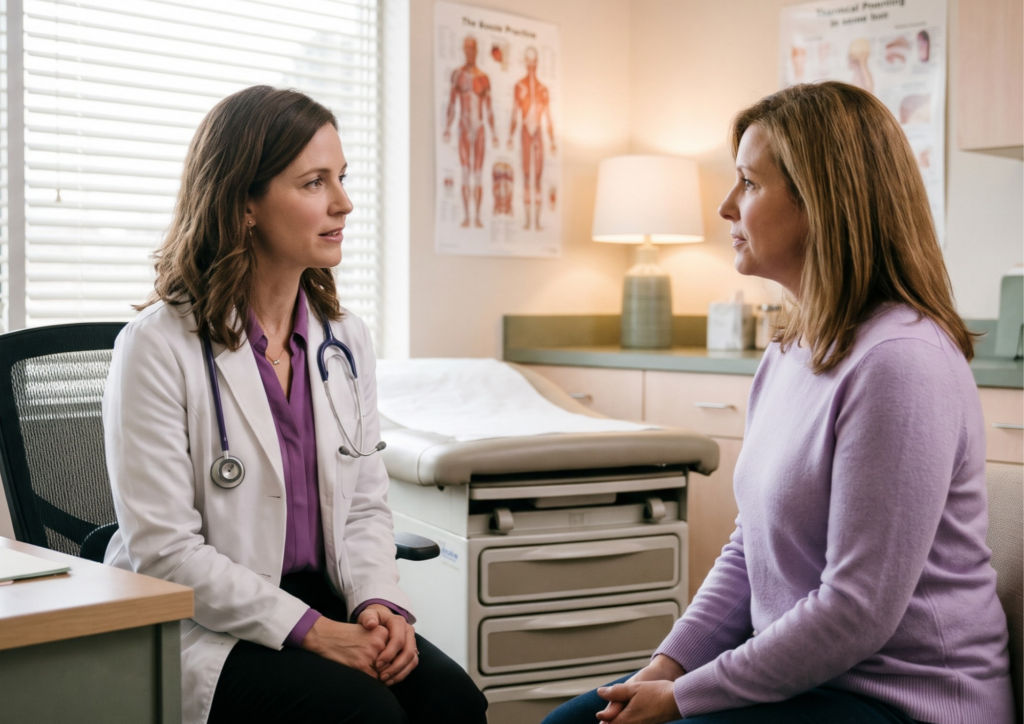
Every October, my exam room fills with two kinds of questions. One is about mammograms. The other is about menopause. More often than you’d expect, they come from the same woman during the same visit.
That makes sense. Breast cancer risk rises with age, and so do the questions about hot flashes, sleep, and whether hormone therapy is safe. With Breast Cancer Awareness Month and World Menopause Day (October 18) landing in the same few weeks, I want to put both conversations in one place.
When should you start mammograms?
For women at average risk, the U.S. Preventive Services Task Force recommends screening mammograms every two years from age 40 through 74. The starting age moved from 50 down to 40 in 2024. Part of the reason was that more women are being diagnosed in their 40s. Part of it was that Black women are more likely to die from breast cancer and more likely to be diagnosed young.
Some women choose a yearly mammogram after we talk it through. Yearly screening may catch some cancers a little sooner. It also brings more callbacks and more biopsies for findings that turn out to be nothing. Neither choice is wrong. It should be your choice, made with good information and a physician who knows your history.
Who may need a different plan?
Your screening may need to start earlier, happen more often, or include other imaging like a breast MRI if you have any of the following:
- A personal history of breast cancer or certain noncancerous breast conditions
- A parent, sibling, or child who has had breast cancer
- A known inherited gene mutation linked to breast cancer, such as BRCA1 or BRCA2
- Radiation treatment to the chest in the past, especially at a young age
- Dense breast tissue noted on a prior mammogram
If you aren’t sure where you fall, that’s a conversation I’m always glad to have. It usually starts with family history, which is why I’ll ask about yours more than once. Mind you, family history means more than breast cancer. Ovarian, pancreatic, and prostate cancer in close relatives can matter too.
Know what’s normal for you.
You don’t need to perform a perfect monthly exam. What matters is knowing how your breasts usually look and feel, so you notice when something changes. Call your physician promptly if you notice:
- A new lump or thickened area in the breast or underarm
- A change in breast size, shape, or appearance
- Skin dimpling, redness, scaling, or thickening
- A nipple that newly turns inward, or nipple discharge, especially if it’s bloody
- Pain in one specific spot that doesn’t go away
Most breast changes are not cancer. Every one of them deserves an evaluation instead of a wait-and-see.
The hormone therapy question
This is the one I hear most from women in their 40s and 50s: “If I start hormone therapy for my symptoms, am I raising my risk of breast cancer?”
For more than twenty years, the honest answer got buried under fear. In early 2026, the FDA approved updated labels for menopausal hormone therapy that removed breast cancer, heart disease, and dementia from the boxed warning, the most prominent warning a drug can carry. The risk information still appears in the label. It’s no longer the headline, because the research now shows that for many healthy women who begin treatment before 60 or within about ten years of menopause, the benefits often outweigh the risks.
That doesn’t mean there’s no risk. Combined estrogen and progestogen therapy is associated with a small increase in breast cancer risk that grows with longer use. Hormone therapy can also make breast tissue denser on a mammogram for some women, which is one more reason to stay current on screening while you’re taking it. For women with a personal history of breast cancer, hormone therapy usually isn’t the right fit, and there are several effective non-hormonal treatments for hot flashes and sleep.
The right answer depends on your age, your symptoms, your family history, and your own breast health. That’s a whole-picture decision, and it’s exactly the kind of conversation I built my practice to have.
What you can do this month
- Look up the date of your last mammogram.
- Schedule your screening if you’re due.
- Update your family history, especially if a relative has had breast, ovarian, pancreatic, or prostate cancer.
- Keep moving, limit alcohol, avoid tobacco, and work toward a healthy weight where you can.
- Encourage a friend, sister, or mother to stay current with her screening too.
If you’re due for a mammogram, or you’d like to talk through your risk or your options for menopause symptoms, call our office at (980) 431-4437 or use the patient portal to schedule your preventive visit, vaccine appointment, or recommended screening. We’d be honored to walk this season with you.
Your Friendly Neighborhood Family Doctor,
